 blog
Best Equipment Rentals for Small Concrete Driveway Projects
Quick Summary
The best equipment for small concrete driveway projects is a mixer for steady batches, a plate compactor to pack the base, a walk-behind saw for control joints, and hand finishing tools. Map every stage first, since demolition, base prep, pouring and finishing each need different tools.
- Measure length, width and about 4 inches of depth, then add 5 to 10 percent for waste.
- Rent a mixer when you need more than roughly half a cubic yard of concrete.
- Compact the base in lifts of about 4 inches, with two to three passes per lift.
- Cut control joints about a quarter of the slab depth, no more than 10 feet apart, within a few hours of finishing.
- Rental rates often drop from daily to weekly, so compare both quotes before booking.
Table of Contents
- Planning Your Small Concrete Driveway Project Before You Rent
- Concrete Mixer Rental: Mixing Your Own Batches
- Equipment to Break Up Concrete on an Existing Driveway
- Concrete Saw Rental for Control Joints and Cuts
- Concrete Finishing Tool Rental and Base Preparation Equipment
- Comparing Rental Options, Transportation and Rental Duration
- Booking Your Equipment Rental With Hoke Rentals
- Frequently Asked Questions
Planning Your Small Concrete Driveway Project Before You Rent
Renting the right equipment starts long before you pick up a phone. A small concrete driveway project usually runs through four stages: demolition or removal of the old surface, excavation and base preparation, forming and pouring, and finishing and curing. Each stage needs different tools, so map the whole job first.
Measure the driveway in square feet and estimate the concrete depth. Most residential driveways are poured about 4 inches thick, with thicker sections where vehicles turn or park. Multiply length by width by depth, convert to cubic yards, and add 5 to 10 percent for waste and uneven subgrade. That number tells you how much mixing capacity you need and whether you should buy ready-mix instead.
Check your site before booking anything. Note slopes, tree roots, overhead lines, and where the truck or trailer will park. Narrow gravel lanes limit what you can bring in. Ask your local building department whether a driveway pour needs a permit or a utility locate before digging. Many areas require a call to 811 before any excavation (811 Before You Dig).
Watch out: Renting a machine that is too large for the site often costs more in damage repair and transport than a smaller unit would have, so measure your access points before you choose equipment for concrete driveway projects.
Concrete Mixer Rental: Mixing Your Own Batches
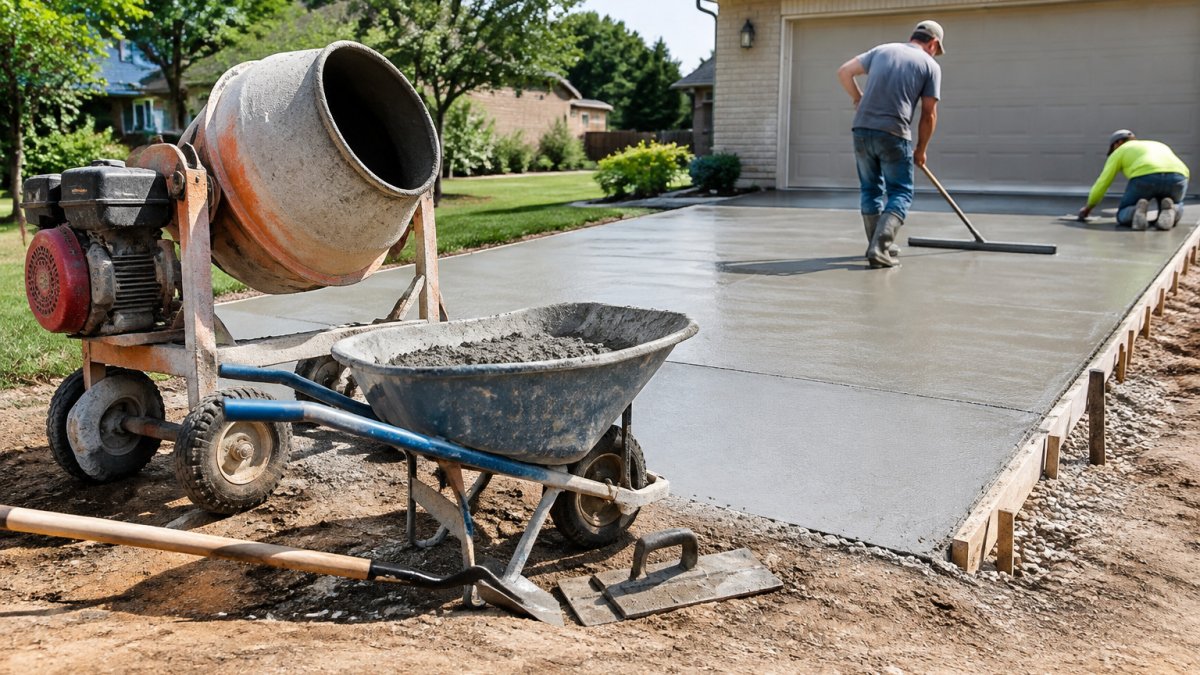
A towable or drum mixer makes sense when you need more concrete than bagged mix can deliver economically, usually above roughly half a cubic yard. For small concrete driveway projects, a mixer lets you pour in steady batches and keep the work moving, which matters because fresh concrete begins to set within about an hour in warm weather.
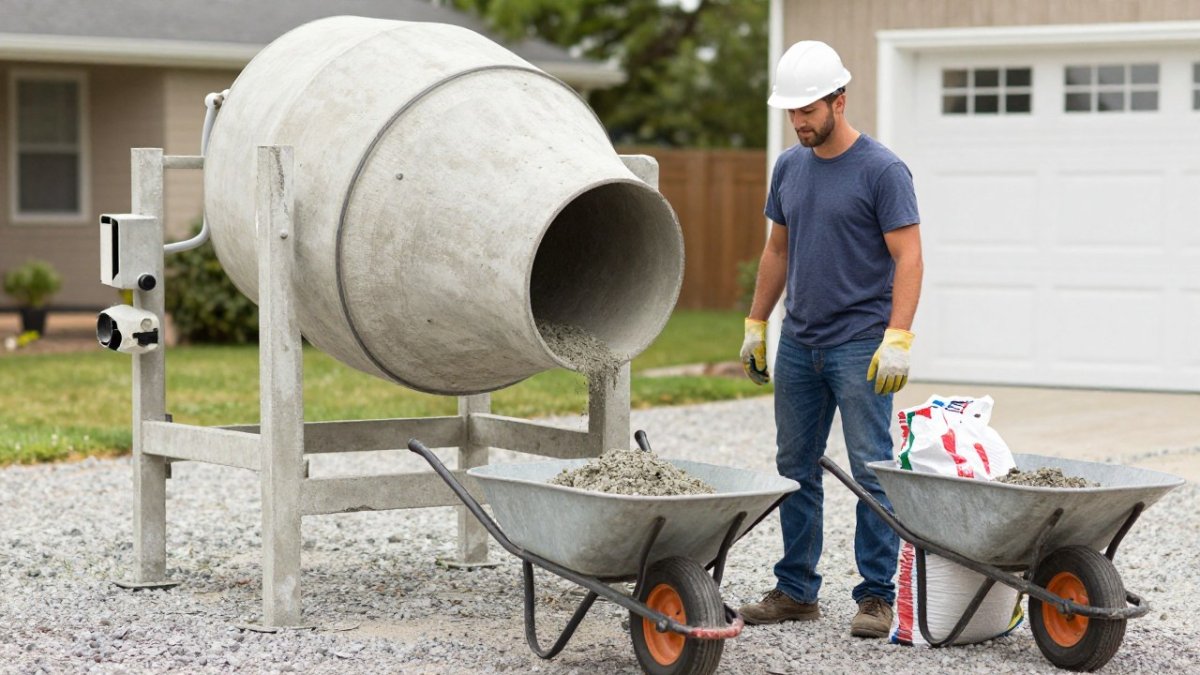
Renting a mixer gives you control over batch size and mix consistency. Plan your batches so each one can be placed and finished before the next arrives. Have aggregate, cement, and water staged within reach, and keep a bucket of clean water nearby for the drum.
Pricing depends on quantity, dates, and delivery. Ask Hoke Rentals for current rates and availability rather than relying on estimates from other sources.
Equipment to Break Up Concrete on an Existing Driveway
If you are replacing an old driveway, you will need to break out the existing slab before forming the new one. Hand tools such as sledgehammers and demolition chisels work on thin sections, but a small electric or pneumatic breaker, or a walk-behind breaker, saves hours on a full slab.
Pick the breaker by the thickness of the old concrete and the amount of rebar. A lighter tool handles four-inch slabs, while reinforced sections need more force and more time. Wear eye and hearing protection, steel-toe boots, and gloves, and use dust control, since broken concrete produces silica dust that can damage lungs.
Plan where the broken material goes before you start. A dump trailer or roll-off container usually handles it, and disposal costs can exceed the equipment rental, so budget for both.
Concrete Saw Rental for Control Joints and Cuts
Control joints keep a new driveway from cracking randomly as it cures. The usual guideline is to cut joints about a quarter of the slab depth deep and no more than 10 feet apart, and to cut them within a few hours of finishing, before the slab shrinks and cracks on its own.
A walk-behind saw with a diamond blade suits most driveway work. Make sure the blade is rated for the aggregate in your mix and that you have water feed to control dust and blade heat. Cut straight, mark your lines first, and keep a helper on the water supply.
A common mistake is waiting too long to cut. If the surface cracks before you saw, the joint no longer does its job.
Concrete Finishing Tool Rental and Base Preparation Equipment
Finishing tools shape the surface and affect both appearance and durability, but the tools only work if the base underneath is right. Treat base preparation and finishing as one continuous workflow, because a slab poured over a soft spot will crack no matter how well you trowel it.
Start with the sub-base. A plate compactor packs the gravel base so the slab does not settle. Compact in lifts of about 4 inches at a time, making two to three passes over each lift, and check that the surface is firm and unyielding underfoot before you form. A common pattern is to compact, water lightly if the base is dusty, and compact again.
If the existing base has high spots or roots, a walk-behind grinder or a small stump grinder may be needed before compaction. Grinders also refresh rough concrete edges and remove form marks on an existing slab you are keeping. Rent a grinder with a diamond cup wheel rated for the material, and use water or a shroud with a vacuum to control silica dust.
Forming comes next. Wood or steel forms set the slab edges and the slope for drainage. A small driveway typically uses 2x4 or 2x6 lumber staked every 3 to 4 feet, with a fall of about 1 inch per 4 feet away from the garage or house. Rent or buy stakes, form oil, and a line level; these are cheap and save hours of rework.
Once the concrete is placed, the finishing sequence matters. A bull float levels the poured concrete and pushes aggregate below the surface. An edger rounds the perimeter to prevent chipping. A magnesium or steel trowel produces the final surface, with magnesium used earlier and steel later for a harder finish.
Rent finishing tools in matched sets when possible. Confirm that the edger and float fit your slab width, that the broom head is clean, and that trowel blades are not worn. A hand float, a margin trowel, and a concrete rake are inexpensive add-ons that prevent you from stopping the pour to hunt for a tool.
Watch out: Renting a power trowel for a small driveway often does more harm than good, because a beginner can burn or wave the surface in seconds. A hand float and broom finish is usually the safer choice for a one- or two-car slab.
Comparing Rental Options, Transportation and Rental Duration
Most equipment guides list tools and stop there. The two decisions that actually blow a small driveway budget are how long you rent and how you get the equipment home. Handle both before you book.
Rental duration math. Rental rates usually drop sharply from daily to weekly. Rental rates often drop from daily to weekly, so ask for both quotes before you book if you expect to need equipment for several days. For a small driveway, the realistic schedule is one day for demolition, one day for excavation and base compaction, one day for forming and pouring, and a partial day for sawing control joints. That is three to four working days, which usually means a weekly booking on the mixer, compactor, and saw is the better deal.
Project-specific rental bundles. Instead of renting item by item, build a bundle around your driveway size. For a one-car driveway (roughly 10 by 20 feet, about 200 square feet), the core tools usually include a drum or towable mixer, a plate compactor, a walk-behind concrete saw, and hand finishing tools. For a two-car driveway (roughly 20 by 20 feet, about 400 square feet), plan for more mixing capacity and a longer saw run. If you are replacing an old slab, add a breaker and a way to haul away debris.
Transportation and towing. This is where most DIYers get surprised. A towable mixer, a plate compactor, and a walk-behind saw can usually go in a pickup bed or on a small utility trailer, but a mini excavator or a dump trailer needs a trailer with brakes and a tow vehicle rated for the combined weight. Check your truck's tow rating, the trailer's gross vehicle weight rating, and the tongue weight before you book. Confirm that the hitch ball size matches the trailer coupler, that the trailer lights work, and that you have ramps and a second person to load safely.
Delivery versus pickup. Ask whether any delivery option includes placement and pickup, and confirm the details with Hoke Rentals when you request a quote.
Best for: homeowners and small contractors renting a full set of tools for one driveway pour. Skip if: you only need a single hand tool you can buy for less.
The table below summarises the key figures and checks to confirm before you book a rental.
| Item | Value | Note |
|---|---|---|
| Typical driveway thickness | About 4 inches | Thicker where vehicles turn or park |
| Mixer threshold | Roughly half a cubic yard | Above this, mixing beats bagged mix |
| Control joint depth | About 1/4 slab depth | Cut within a few hours of finishing |
| Control joint spacing | No more than 10 feet apart | Prevents random cracking |
| Base compaction lift | About 4 inches per lift | Two to three passes per lift |
| Form slope | About 1 inch per 4 feet | Fall away from house or garage |
| One-car driveway | Roughly 10 by 20 feet | Around 200 square feet |
| Two-car driveway | Roughly 20 by 20 feet | Around 400 square feet |
Booking Your Equipment Rental With Hoke Rentals
Hoke Rentals serves contractors and DIY customers with construction and jobsite equipment. To reserve a mixer, saw, compactor, or finishing tool, start by browsing our equipment rentals to confirm what we have in stock for your project dates.
If you are ready to book, apply now to request your rental, or contact us to confirm availability, ask about delivery, and get a current quote. Pricing depends on quantity, dates, and delivery, so call or write before you finalize your plan.
For a closer look at choosing excavation equipment for a backyard project, read our guide on mini excavator rental for backyard drainage before you decide on your final equipment list.
Frequently Asked Questions
What equipment is needed for a small concrete driveway project?
A small driveway typically needs a way to mix or deliver concrete, a plate compactor to firm the sub-base, screed boards for leveling, a bull float and edger for finishing, and a saw for control joints. Many DIY builders rent the mixer, compactor and saw and buy the hand tools. Pricing varies with rental length, delivery and equipment type, so request a current quote from Hoke Rentals before scheduling. Plan the full sequence of tools before the pour starts, because concrete sets on a fixed timeline and you cannot pause mid-slab.
What should I rent to break up an old concrete driveway?
For an existing driveway, a walk-behind or handheld breaker, or a small excavator with a hydraulic hammer attachment, handles most residential slabs. Pair the breaker with a concrete saw to cut the slab into manageable sections first, which makes removal easier and reduces the chance of cracking into areas you want to keep. Wear eye and hearing protection and steel-toed boots. Confirm the rental includes the right bit or attachment before you leave.
Should I rent a concrete mixer or order ready-mix concrete for a small driveway?
A rented mixer suits projects where you can mix in batches and work at a steady pace, usually a few cubic yards or less. Ready-mix delivery suits larger single pours because the entire load arrives at once and must be placed quickly. Consider how many trips your mixing will require, how much help you have, and whether your site can accommodate a delivery truck.
How long should I rent concrete equipment for a driveway project?
Rental duration should cover the full workflow: site prep and grading, mixing and placement, finishing, and the first cuts for control joints. Concrete begins setting quickly, so schedule the mixer and finishing tools for the pour day and a shorter window for the saw once the slab has hardened enough to cut without raveling. Extending a rental costs less than rushing a pour, so build in a buffer day. Ask about rental length options when you request a quote.